


SPREME-web
(An analysis tool for ship responses in waves)
SPREME-web is a frequency domain analysis tool for estimating ship motion, hull girder loads, and pressure distribution in waves. SPREME (Strip/Panel-based Response Estimation Method), as its name suggests, allows the user to choose between the strip method and the 3D panel method, and to manipulate input and output data on the same interface for both methods[1].
- In Japan Only

※ The former “NMRIW-Lite Web” has been replaced by “SPREME-web” with higher-level functions as of December 1, 2023.
Outline
SPREME-web is a frequency-domain analysis tool for calculating ship motions, hull girder loads, pressure distributions, and related responses of monohull and multihull vessels in waves. As indicated by its name, SPREME (Strip/Panel-based Response Estimation Method) allows the user to select either the strip method or the 3D panel method for hydrodynamic force calculations. In both approaches, input preparation and result visualization can be performed within the same interface[1]
In this application, hull geometry can be defined through on-screen input operations, by importing an offset table (CSV file), or by automatically generating a mathematical hull form from a small number of principal particulars. Wave conditions can be specified as arbitrary regular or irregular waves. The output data include frequency response functions and time-series data of wave-induced responses (such as six-degree-of-freedom motions and wave loads), their short-term and long-term statistical predictions, and animations of the ship and waves.
Calculation methods (For more details, see Ref. [1])
- ・Linear strip method
…You can choose NSM[2]/ STFM[3], and the application of Mizoguchi/Watanabe correction method[4] to diffraction force. - ・Linear 3D panel method
3D Green’s function method: Kernel function is Green’s function with zero-speed. (based on encounter wave correction method[5])
Output item and output format
Output item
- ・Motion and acceleration (6 DOFs)
- ・Hull girder sectional forces at the selected cross-section (Axial force, Horizontal shear force, Vertical shear force, Vertical bending moment, Horizontal bending moment, and Torsional Moment)
- ・Acceleration on the selected location (Longitudinal, Vertical, and Horizontal (coordinates fixed on a ship))
- ・Water pressure on the selected location
- ・Hydrodynamic force components
Output format
- ・Response function (Amplitude and Phase)
- ・Time series
- ・Long term prediction (Excel sheets with a macro or CSV files)
- ・Animation (VTK format)
- ・Output data for NMRI-DLSA system[6]
Interface
SPREME-web can input data, execute an analysis, and confirm the results through the interface on the browser. Text files of input and output data can be uploaded and downloaded. You can edit and process data by text files as well as operate them on the browser.
Input ship information
This is a screen for inputting principal particulars, hull-form information, weight distribution, etc. Hull-form information can be generated by importing an offset table CSV file, or a mathematical hull-form[7] can be automatically generated from the input of principal particulars (L, B, d and fineness coefficients, etc.).
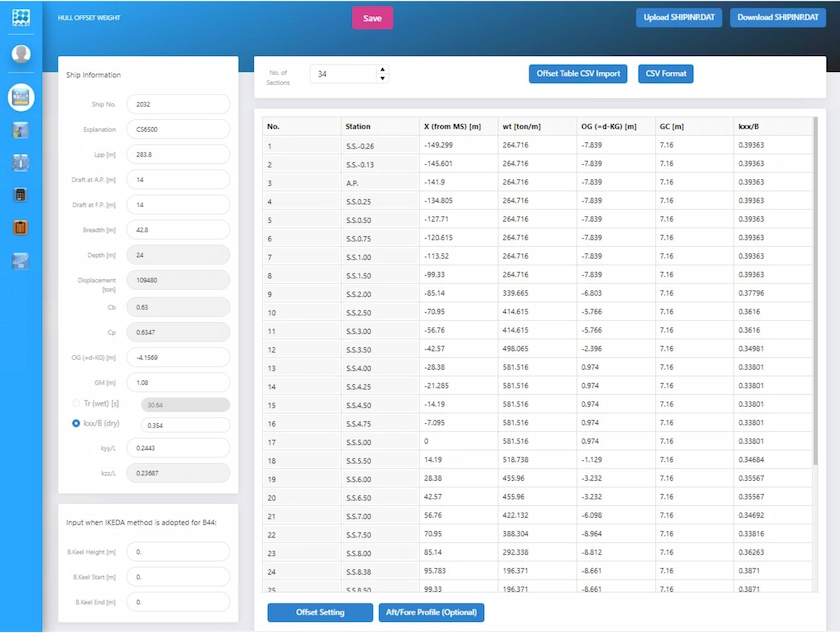
Input screen of principle particulars, weight distribution, etc.
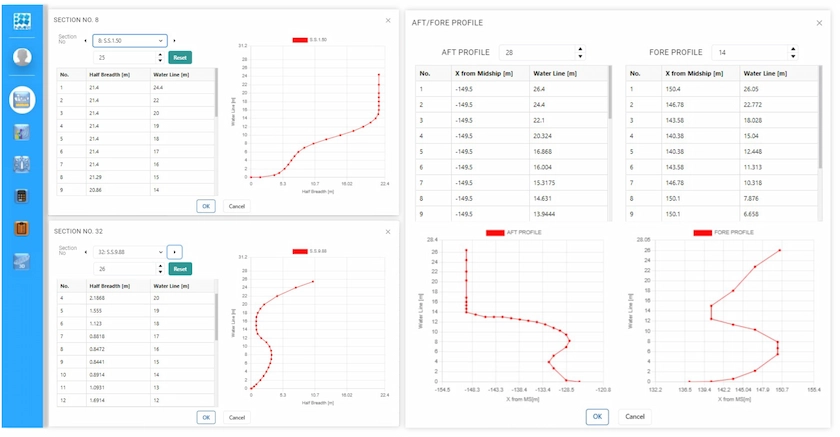
Input screen of ship sectional shapes and aft/fore profile
Function to check input data of a ship
There are functions to check ship information as below. A ship body plan, a buttock line, still water balance, and still water shear force/bending moment can be shown and checked. In addition to calculating of fineness coefficients and the roll natural period, weight distribution is automatically adjusted to balance in still water condition.
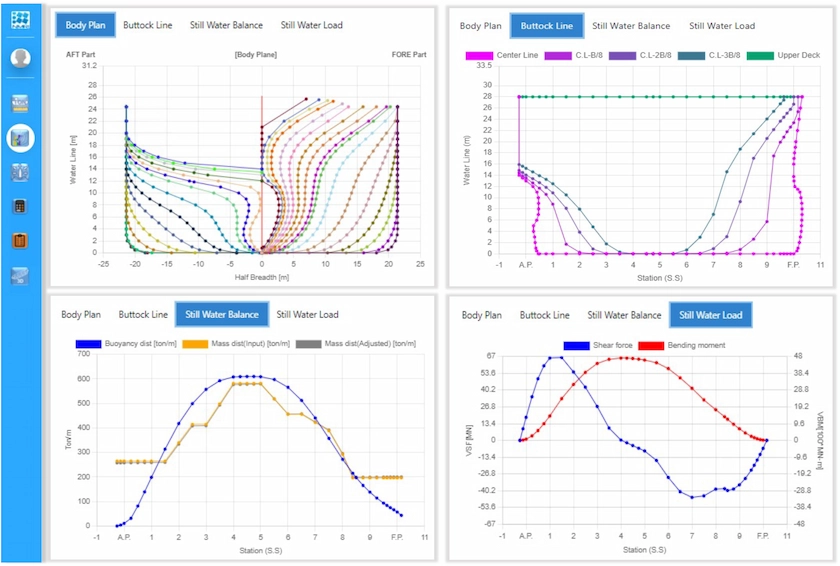
Results calculated by input data of a ship (Body Plan, Buttock Line, Still Water Balance, Still Water Load) (Body Plan, Buttock Line, Still Water Balance, Still Water Load)
Input parameters for the calculation setting
The number of hull surface elements, a method for calculating roll damping coefficient, wave conditions (wave height, wave direction, wave length, and ship speed), and output items and formats can be selected.
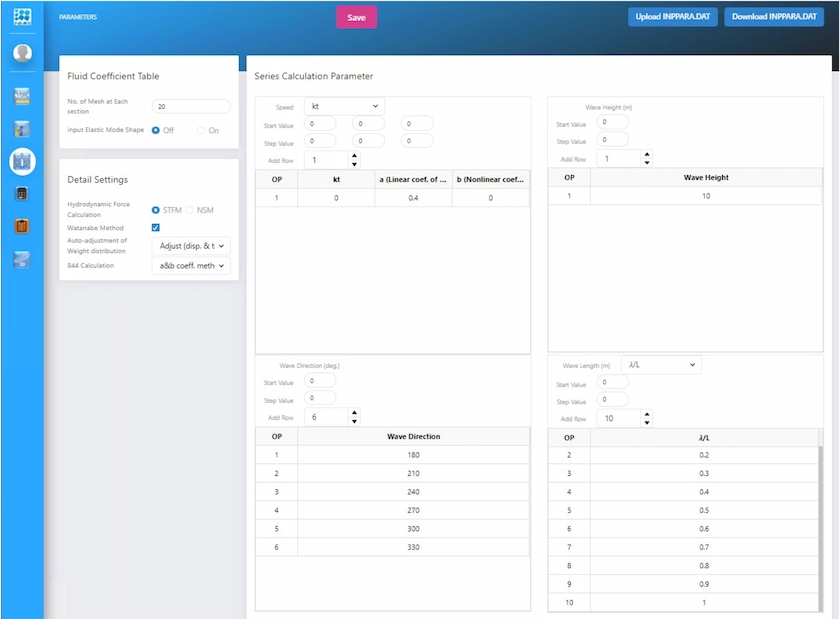
Input screen for calculation parameters
Samples of the output results
Output results can be confirmed on the browser. The files of output results (CSV file) can be also downloaded.
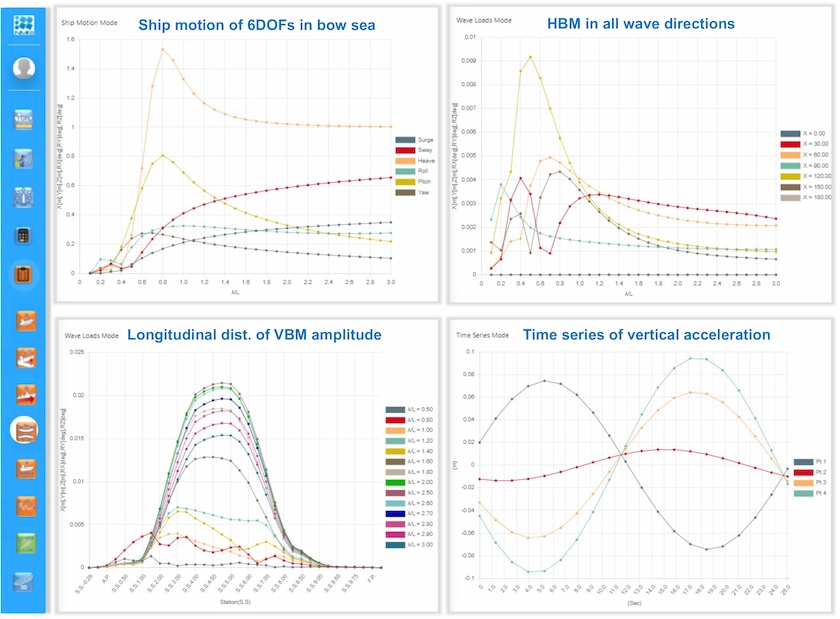
Samples of the display of output results
Long-term prediction
Long-term prediction can be executed when all wave directions are calculated. Based on the frequency response function, a short/long-term prediction can be executed by the calculation in Excel sheets, and the most severe sea conditions can be identified.
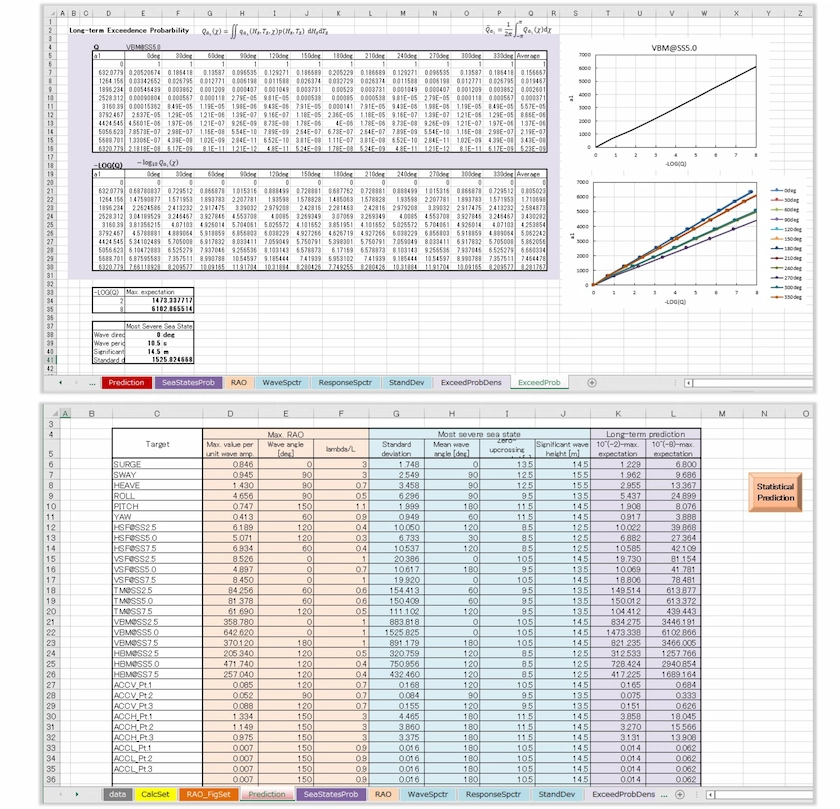
Samples of Excel sheets of long-term prediction
(upper: a long-term exceedance probability of vertical bending moment,lower: The most severe short-term sea condition in total responses and a long-term prediction value)
Animation of the ship response in waves
Animation of the ship response in the selected wave condition can be displayed on the browser. The incident wave, ship motion, distribution of hull girder sectional forces, and pressure distribution are visualized. By downloading the animation data files, the animation can be displayed by Desktop ParaView (free software) .
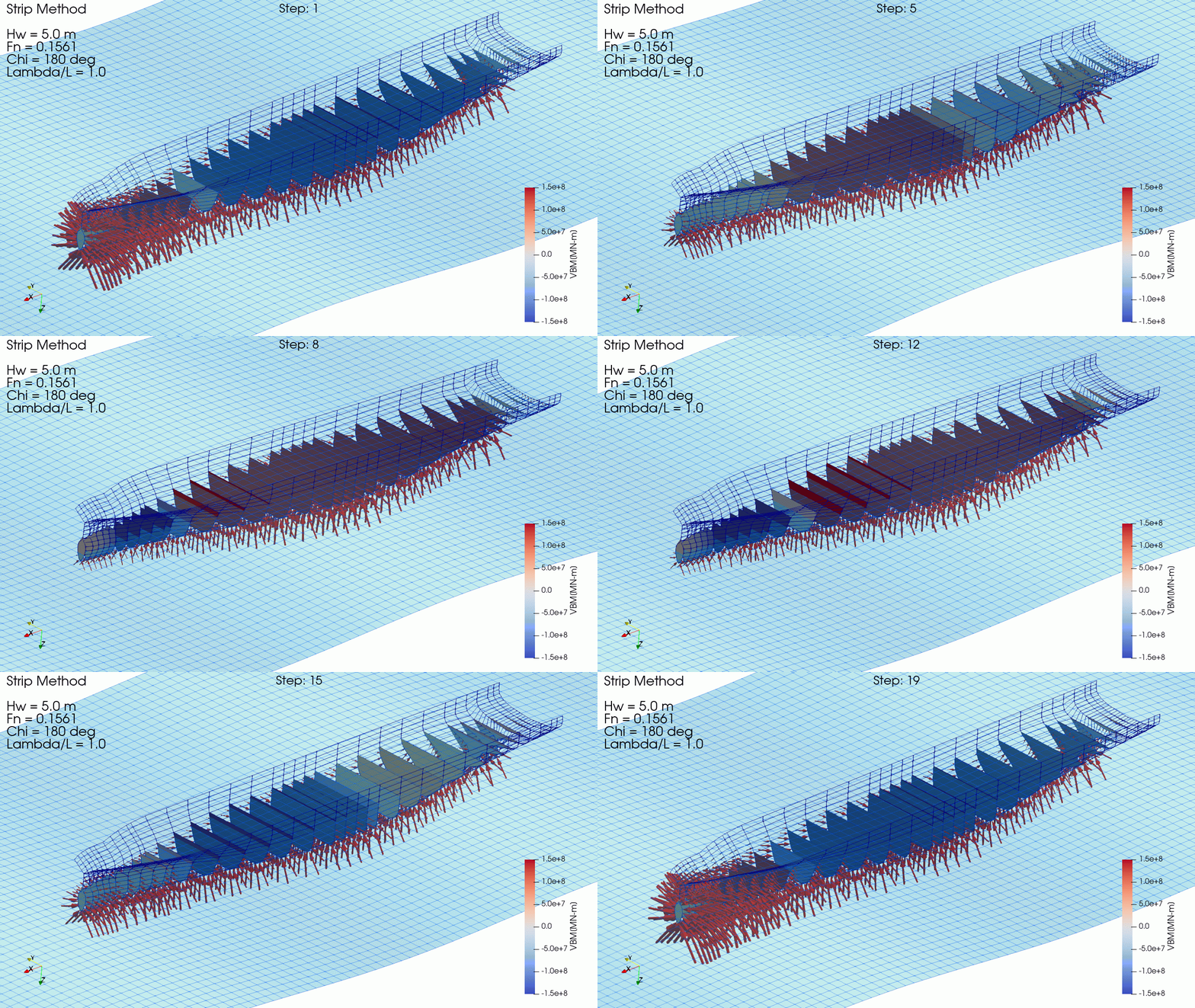
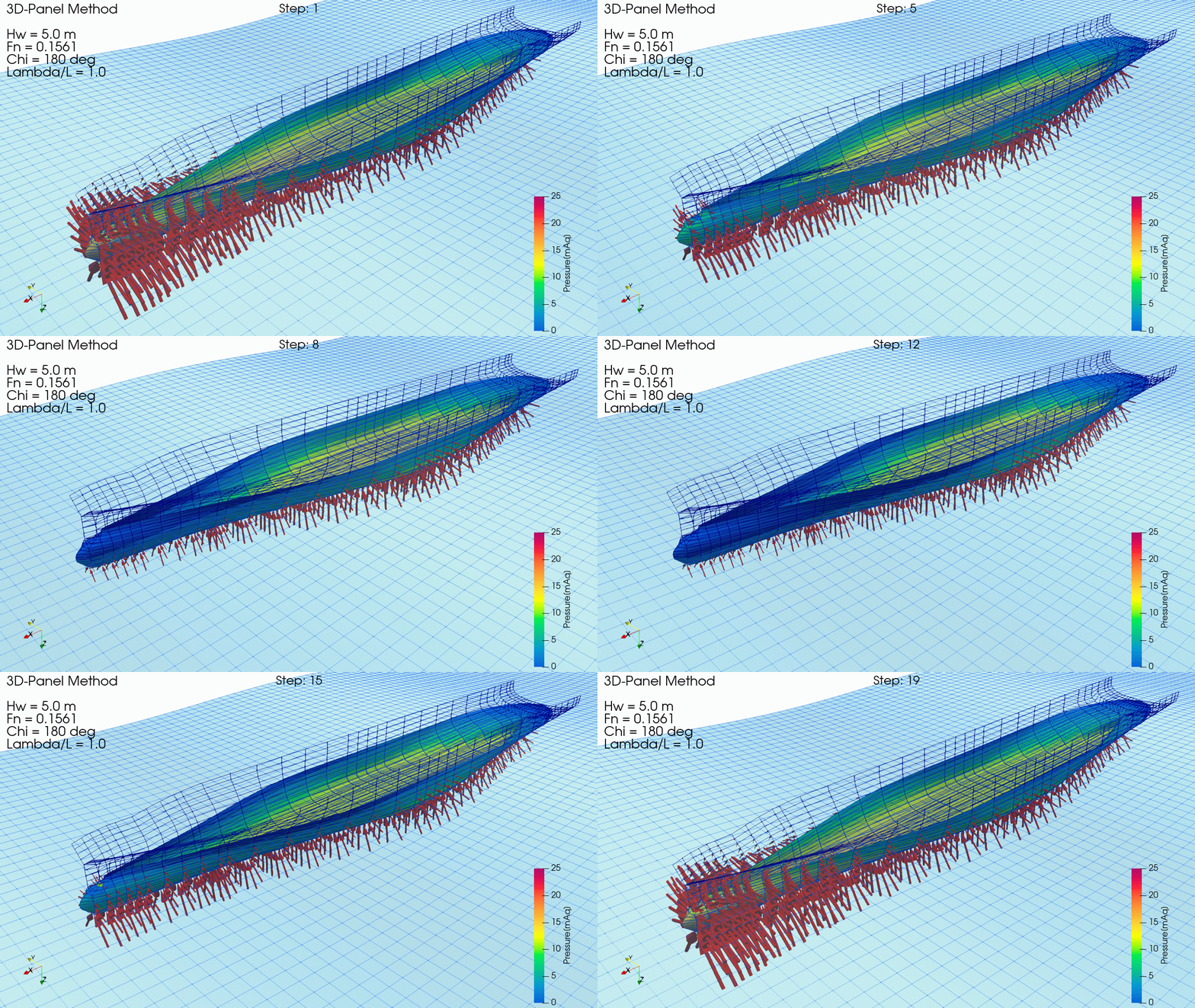
Animation of ship response in regular waves (upper: Strip method, lower: 3D panel method)
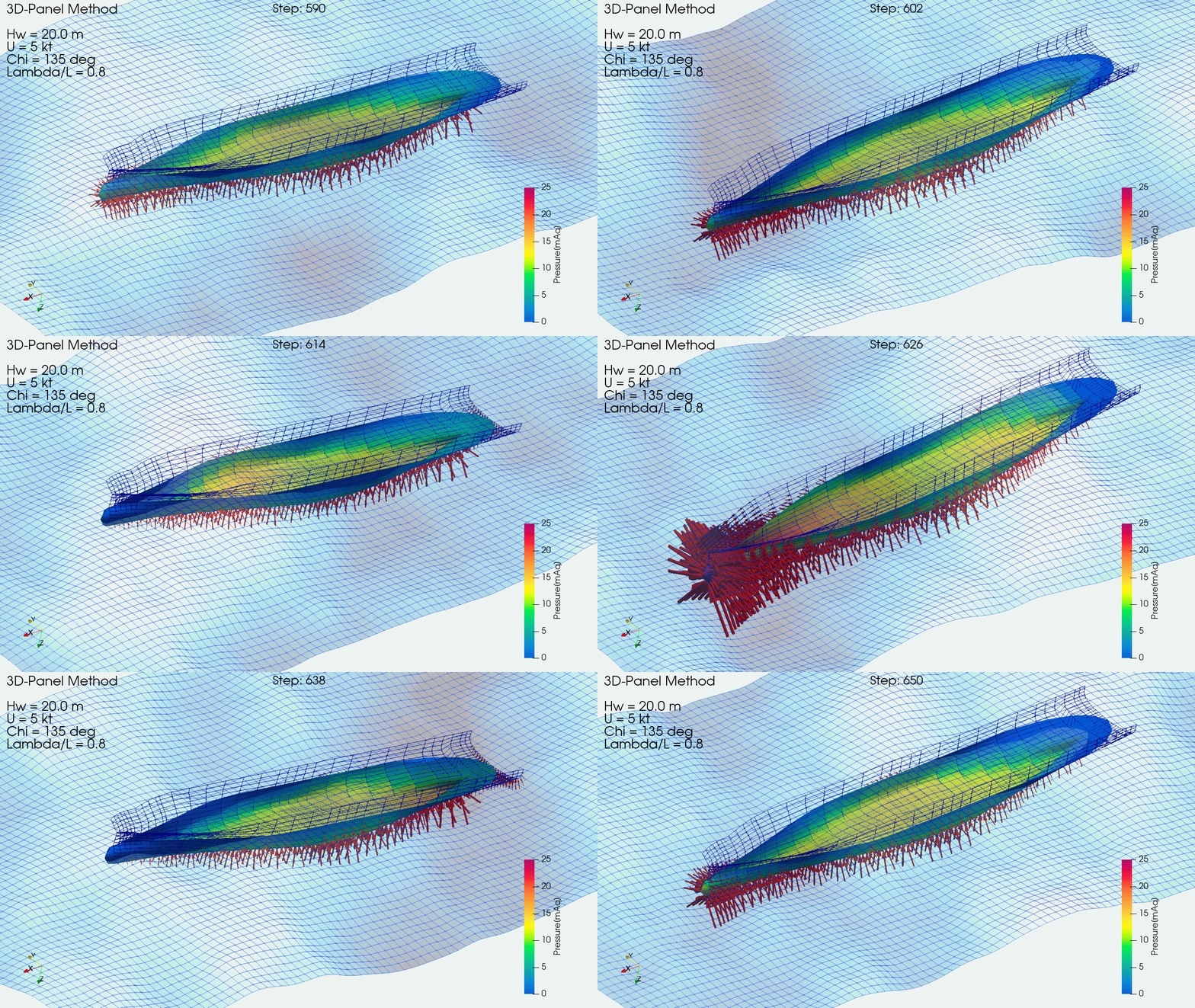
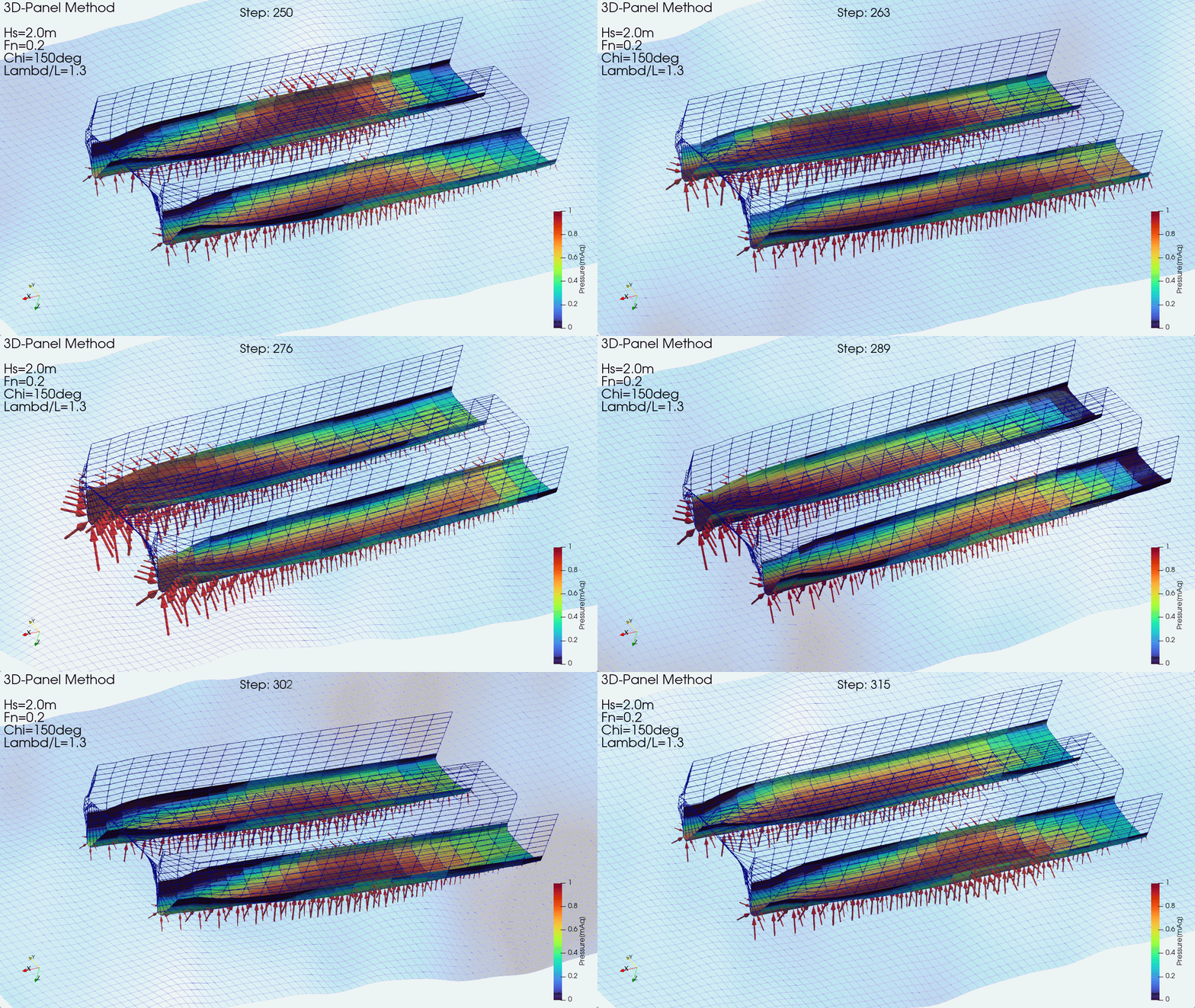
Animation of ship response in irregular waves (3-D panel method)
To use this application
This application is a paid application. To use this application, you must register as a paid membership, and sign a license agreement with the National Maritime Research Institute, Japan. Membership registration is available on the Membership Registration page.
Fees (Annual, Tax included)
| Analysis Capability | Monohull Only | Monohull + Multihull Option |
|---|---|---|
| Linear strip method | ¥300,000 | ¥450,000 |
| Linear 3D panel method | ¥400,000 | ¥600,000 |
| Linear strip method | ¥500,000 | ¥750,000 |
*This price list is for one account. This application does not allow the same account to log in from multiple devices at the same time.
References
- [1]Matsui, S., Takeda, K. and Sugimoto, K.: Difference in ship response in waves between strip and 3D methods based on integrated formulation, Ocean Engineering, Vol.305, 2024. https://doi.org/10.1016/j.oceaneng.2024.117908
- [2]Tasai, F., Takagi, M.: Theory and Calculation Method for Ship Response in Regular Waves, The 1st Marine Dynamics Symposium, The Society of Naval Architects of Japan、pp.1-52, 1969. (in Japanese)
- [3]Salvesen, N., Tuck, E., and Faltinsen, O.: SHIP MOTIONS AND SEA LOADS. 1970.
- [4]Watanabe, I., Toki, N., Ito, A.: Chapter 2 Strip Method, The 11th Marine Dynamics Symposium, Applications of ship motion theory to design, 1994. (in Japanese)
- [5]Papanikolaou, A. and Schellin, T.: A three-dimensional panel method for motions and loads of ships with forward speed, Ship Technology Research,Vol.39, pp.145, 1992.
- [6]Matsui, S., Murakami, C., Hayashibara, H., and Fueki, R.: Development of Direct Load and Structure Analysis and Evaluation System on Whole Ship DLSA-Basic for Ship Structural Design, Papers of National Maritime Research Institute, Vol.19, pp.1-21, 2019. (in Japanese)
- [7]Matsui, S.: A new mathematical hull-form with 10-shape parameters for evaluation of ship response in waves, 2022. https://doi.org/10.1007/s00773-021-00849-3